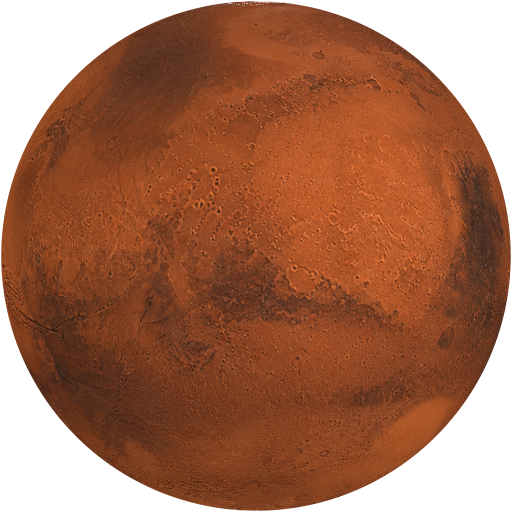
Fourth planetRocky world
A cold desert world rusted red by iron oxide. Mars hosts the tallest volcano and the deepest canyon in the Solar System - and once had rivers and lakes.
Key facts
Mass
0.107
× Earth
Radius
3,390 km
0.53× Earth
Gravity
3.71 m/s²
38% Earth
Temp
-65°C
mean
Orbit & rotation
227.9 M km
from the Sun
1.52 AU
687 days
orbital period
1.9 Earth years
24.6 hours
length of day
a “sol”
Sunlight reaches here in 13 min
travelling at 299,792 km/s
Compared to Earth
Radius
0.532× Earth
Smaller than Earth.
Surface gravity3.71 m/s²
Blue line = Earth · scale 0–25 m/s²
A 70 kg person weighs26 kghere
Temperature
-65°Cmean surface
Pluto −230°Earth +15°Venus +465°
Atmosphere
Carbon dioxide95%
Nitrogen2.8%
Argon2%
Moons & rings
2 moons
Phobos ›Deimos ›
Rings None (Phobos may form one in ~50 M years).
Notable
- Olympus Mons is the tallest volcano known - nearly 3× the height of Everest.
- Valles Marineris canyon stretches over 4,000 km.
- It has seasons and polar ice caps, like Earth.
-
Discovery
Known since antiquity
Missions & exploration
1965
Mariner 4FlybyNASA
First close-up pictures of another planet.
1971
Mariner 9OrbiterNASA
First spacecraft to orbit another planet.
1971
Mars 3LanderUSSR
First soft landing on Mars, though contact lasted only seconds.
1976
Viking 1LanderNASA
First fully successful Mars landing; searched for signs of life.
1997
Mars Global SurveyorOrbiterNASA
Mapped Mars globally and transformed the modern view of its geology.
1997
PathfinderRoverNASA
Delivered Sojourner - the first rover on another planet.
2001
Mars OdysseyOrbiterNASA
Long-lived orbiter that mapped hydrogen and relayed surface missions.
2003
Mars ExpressOrbiterESA
ESA’s first planetary mission, still studying Mars and its moons.
2004
Spirit & OpportunityRoverNASA
Twin rovers; Opportunity drove 45 km over 14 years.
2006
Mars Reconnaissance OrbiterOrbiterNASA
High-resolution imaging workhorse and major relay for Mars surface missions.
2012
CuriosityRoverNASA
Car-sized nuclear-powered laboratory, still driving in Gale crater.
2014
MAVENOrbiterNASA
Studies how Mars lost much of its atmosphere to space.
2018
InSightLanderNASA
Placed a seismometer on Mars and revealed the planet’s deep interior.
2021
HopeOrbiterUAE Space Agency
The first Arab interplanetary mission, built to monitor Mars weather globally.
2021
Tianwen-1 / ZhurongRoverCNSA
China’s first Mars mission combined an orbiter, lander and rover.
2021
PerseveranceRoverNASA
Caching samples for return; its helicopter Ingenuity made the first flight on another planet.
Inside Mars
Crust98–100% of radius
24–72 km thick - thicker in the south
Mantle53–98% of radius
Sluggish; volcanism has mostly ceased
Core0–53% of radius
Liquid iron–sulfur, surprisingly large
Getting there from Earth
At light speed
56 million km
3.1 min
Fastest real trip
Typical transfer
≈7 months
By airliner
900 km/h, non-stop
7.1 years
By car
100 km/h, no breaks
64 years
Distances at closest approach; real routes are longer.