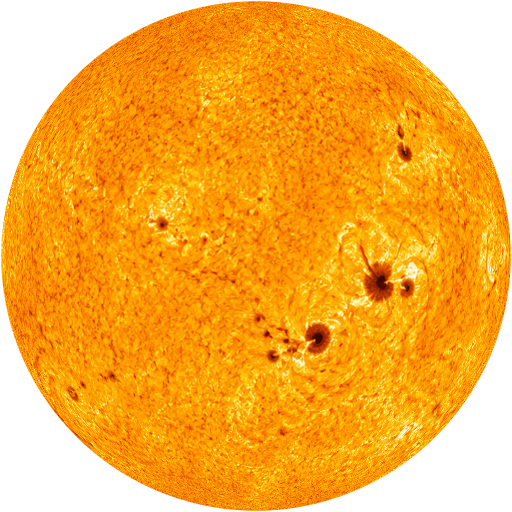
G-type main-sequence starPlasma star
A 4.6-billion-year-old ball of hot plasma holding the entire Solar System in its gravity. It converts 600 million tonnes of hydrogen into helium every second.
Key facts
Mass
333,000
× Earth
Radius
696,340 km
109× Earth
Surface
5,505°C
core ≈15M°C
Composition
Plasma
H + He
Orbit & rotation
-
from the Sun
centre of system
230 M yr
orbital period
around the galaxy
25–35 days
length of day
differential rotation
Compared to Earth
Radius
109.0× Earth
Shown at reduced scale - true radius is 109.0× Earth.
Composition
Hydrogen73%
Helium25%
Other2%
Moons & rings
8 planets orbit it (+5 dwarfs, 1M+ known asteroids)
Rings None - but 99.86% of the system’s mass.
Notable
- Light from its surface takes about 8 minutes 20 seconds to reach Earth.
- Over 1.3 million Earths could fit inside it.
- Its core fuses hydrogen at roughly 15 million °C.
-
Discovery
Known since the dawn of humanity
Missions & exploration
1976
Helios-BFlybyNASA/DLR
Held the record for closest approach to the Sun for over 40 years.
1990
UlyssesOrbiterESA/NASA
First mission to survey the Sun’s polar regions from a high-inclination orbit.
1995
SOHOObservatoryESA/NASA
Three decades of continuous solar watch; discovered 5,000+ comets by accident.
2018
Parker Solar ProbeOrbiterNASA
First craft to fly through the corona - the fastest human-made object, ~690,000 km/h.
2020
Solar OrbiterOrbiterESA/NASA
Capturing the first close images of the Sun’s poles.
Inside The Sun
Convective zone71–100% of radius
Churning plasma hauls heat to the surface
Radiative zone25–71% of radius
Photons take ~170,000 years to work their way out
Core0–25% of radius
Hydrogen fusion at 15 million °C
Getting there from Earth
At light speed
149.6 million km
8.3 min
Fastest real trip
Parker Solar Probe
85 days
By airliner
900 km/h, non-stop
19 years
By car
100 km/h, no breaks
171 years
Distances at closest approach; real routes are longer.