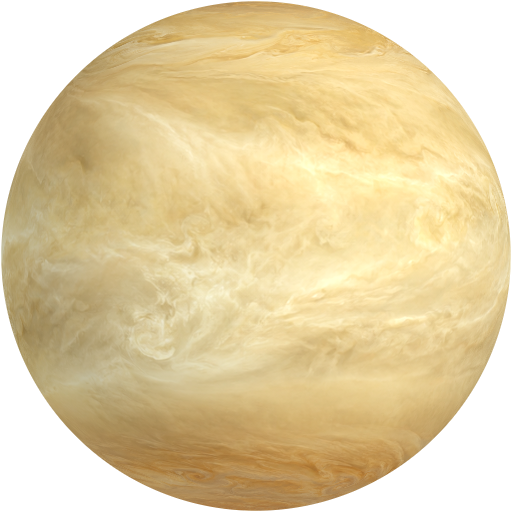
Second planetRocky world
Wrapped in dense clouds of sulfuric acid, Venus is the hottest planet in the Solar System - a runaway greenhouse hot enough to melt lead.
Key facts
Mass
0.815
× Earth
Radius
6,052 km
0.95× Earth
Gravity
8.87 m/s²
91% Earth
Temp
464°C
hottest planet
Orbit & rotation
108.2 M km
from the Sun
0.72 AU
225 days
orbital period
orbital year
243 days
length of day
retrograde
Sunlight reaches here in 6.0 min
travelling at 299,792 km/s
Compared to Earth
Radius
0.949× Earth
Smaller than Earth.
Surface gravity8.87 m/s²
Blue line = Earth · scale 0–25 m/s²
A 70 kg person weighs63 kghere
Temperature
+464°Cmean surface
Pluto −230°Earth +15°Venus +465°
Atmosphere
Carbon dioxide96.5%
Nitrogen3.5%
Moons & rings
0 moons
Rings None.
Notable
- It rotates backwards - on Venus the Sun rises in the west.
- A day on Venus is longer than its year.
- Surface pressure is 92× Earth’s - like being 900 m underwater.
-
Discovery
Known since antiquity
Missions & exploration
1962
Mariner 2FlybyNASA
The first successful mission to another planet.
1967
Venera 4Atmospheric probeUSSR
First direct measurements returned from another planet’s atmosphere.
1970
Venera 7LanderUSSR
First soft landing on another planet - it survived 23 minutes.
1975
Venera 9LanderUSSR
Sent the first photographs from another planet’s surface.
1982
Venera 13LanderUSSR
Returned color panoramas and surface measurements from Venus for over two hours.
1985
Vega 1 & 2BalloonUSSR/International
Dropped the first balloons to operate in another planet’s atmosphere.
1990
MagellanOrbiterNASA
Radar-mapped 98% of the surface straight through the clouds.
2006
Venus ExpressOrbiterESA
ESA’s first Venus mission watched the atmosphere and plasma environment for years.
2015
AkatsukiOrbiterJAXA
Studied the atmosphere’s mysterious 360 km/h super-rotation.
Inside Venus
Crust98–100% of radius
Basaltic rock, ~50 km thick
Rocky mantle51–98% of radius
Hot silicate rock, no plate tectonics
Iron core0–51% of radius
Likely at least partly molten
Getting there from Earth
At light speed
40 million km
2.2 min
Fastest real trip
Mariner 2
110 days
By airliner
900 km/h, non-stop
5.1 years
By car
100 km/h, no breaks
46 years
Distances at closest approach; real routes are longer.