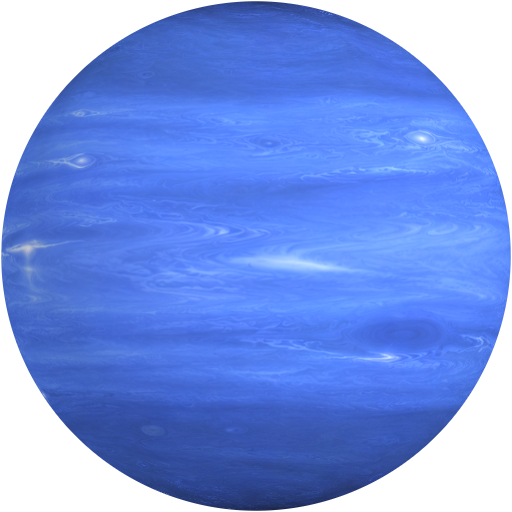
Eighth planetIce giant
The most distant planet - a deep-blue ice giant with the fiercest winds in the Solar System, reaching over 2,000 km/h.
Key facts
Mass
17
× Earth
Radius
24,622 km
3.9× Earth
Gravity
11.15 m/s²
1.14× Earth
Temp
-200°C
cloud tops
Orbit & rotation
4.5 B km
from the Sun
30.1 AU
165 yrs
orbital period
orbital year
16.1 hours
length of day
rotation
Sunlight reaches here in 4h 10m
travelling at 299,792 km/s
Compared to Earth
Radius
3.86× Earth
Shown at reduced scale - true radius is 3.86× Earth.
Surface gravity11.15 m/s²
Blue line = Earth · scale 0–25 m/s²
A 70 kg person weighs80 kghere
Temperature
-200°Cmean surface
Pluto −230°Earth +15°Venus +465°
Atmosphere
Hydrogen80%
Helium19%
Methane1.5%
Moons & rings
16 known moons
Triton ›NereidProteus
Rings 5 faint rings with bright arcs.
Notable
- Its existence was predicted by mathematics before it was ever seen.
- Winds reach over 2,100 km/h - the fastest of any planet.
- Triton orbits backwards and may be a captured dwarf planet.
1846
Discovery
Predicted by Le Verrier, observed by Galle
Missions & exploration
1989
Voyager 2FlybyNASA
The only visit - discovered the Great Dark Spot and Triton’s nitrogen geysers.
Inside Neptune
H/He atmosphere82–100% of radius
The windiest weather layer known
Icy mantle20–82% of radius
Superionic water - it may rain diamonds
Rocky core0–20% of radius
Slightly heavier than Earth’s core
Getting there from Earth
At light speed
4,300 million km
3h 59m
Fastest real trip
Voyager 2
12 years
By airliner
900 km/h, non-stop
545 years
By car
100 km/h, no breaks
4,905 years
Distances at closest approach; real routes are longer.