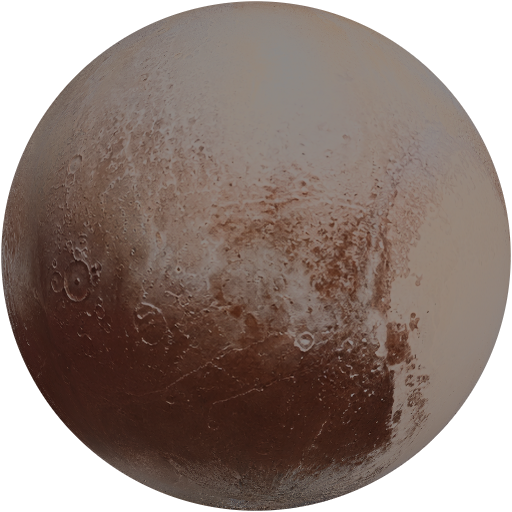
Dwarf planetIcy dwarf
Once the ninth planet, now the most famous dwarf planet. This frozen world of nitrogen ice has a heart-shaped glacier and a moon nearly half its own size.
Key facts
Mass
0.0022
× Earth
Radius
1,188 km
0.19× Earth
Gravity
0.62 m/s²
6% Earth
Temp
-229°C
frozen
Orbit & rotation
5.9 B km
from the Sun
39.5 AU
248 yrs
orbital period
orbital year
6.4 days
length of day
rotation
Sunlight reaches here in 5h 29m
travelling at 299,792 km/s
Compared to Earth
Radius
0.186× Earth
Smaller than Earth.
Surface gravity0.62 m/s²
Blue line = Earth · scale 0–25 m/s²
A 70 kg person weighs4 kghere
Temperature
-229°Cmean surface
Pluto −230°Earth +15°Venus +465°
Atmosphere
Nitrogen99.7%
Methane0.25%
Carbon monoxide0.05%
Moons & rings
5 moons
Charon ›NixHydraStyxKerberos
Rings None.
Notable
- Reclassified from planet to “dwarf planet” in 2006.
- Its largest moon, Charon, is nearly half Pluto’s size.
- The heart-shaped Tombaugh Regio is a vast glacier of nitrogen ice.
1930
Discovery
Discovered by Clyde Tombaugh
Missions & exploration
2015
New HorizonsFlybyNASA
A 9.5-year, 5-billion-km cruise for one spectacular day of close-ups.
Inside Pluto
Ice surface97–100% of radius
Frozen nitrogen, methane and carbon monoxide
Water-ice mantle70–97% of radius
May hide a liquid ocean beneath
Rocky core0–70% of radius
About two-thirds of Pluto’s diameter
Getting there from Earth
At light speed
4,280 million km
3h 58m
Fastest real trip
New Horizons
9.5 years
By airliner
900 km/h, non-stop
543 years
By car
100 km/h, no breaks
4,883 years
Distances at closest approach; real routes are longer.